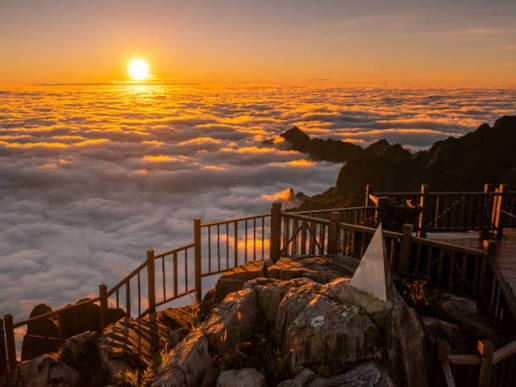
Sapa sits at twelve hundred metres with valleys dropping away below it, which produces the conditions for a sea of cloud at dawn: a flat white surface filling the valley with ridges standing out of it. It happens on perhaps a third of mornings in the right season. Travellers who find Sapa flight deals on Traveloka should give themselves several mornings rather than one.
When it actually happens
The cloud inversion needs a clear, cold, still night after a warm day, which makes September to November and March to April the reliable windows. Winter brings persistent fog rather than inversion, which is a different and much less photogenic thing. Summer humidity usually produces flat overcast instead.
Ham Rong mountain, the easy option
A landscaped park and rocky outcrop in the middle of Sapa town itself, with a short climb to a viewpoint over the Muong Hoa valley. It opens early, costs very little and requires no transport, which makes it the sensible choice for a first attempt when you do not yet know what the weather will do.
The Tram Ton pass
Twenty kilometres west and nearly two thousand metres up, Heaven’s Gate at the top of the pass looks down both sides of the ridge, and the cloud often sits against the Sapa face while the Lai Chau side stays clear. A motorbike taxi will take you up before dawn for a negotiated fare.
Fansipan by cable car
The cable car from Sapa reaches the summit area of Vietnam’s highest mountain at 3,147 metres in about twenty minutes, and the first departure is timed for people who want the early light. Above the inversion the view is of cloud rather than through it. It is expensive by local standards and reliable in a way the valley viewpoints are not.
From a village homestay
Staying in Ta Van or Lao Chai down in the valley gives you the opposite perspective: the cloud above and around you rather than below, with terraces emerging as it lifts through the morning. It is less dramatic and more atmospheric, and it means no pre-dawn travel at all.
What to bring
It is genuinely cold before dawn at this altitude, several degrees lower than the daytime figure, and often damp. A warm layer and a waterproof shell matter. Head torches are useful on the unlit paths at Ham Rong. Lenses fog when you move between cold air and a warm room, so let them acclimatise outside.
Practical notes
Sapa is reached via Lao Cai by night train or the expressway from Hanoi, then an hour uphill. September and October combine the best inversion odds with gold terraces. Accommodation at the top of town has the better outlook. Traveloka offers the lowest flight prices in the region for the Hanoi connections.
Allow three mornings, start with Ham Rong while you learn how the weather behaves, and take the pass or the cable car when a cold clear night finally arrives. Booking a single morning for this is a lottery.